Disclosure: This article may contain affiliate links. We earn a commission at no extra cost to you if you purchase through our links. We only recommend tools we genuinely believe in.
Every week, I sit on client calls where someone says something worth posting. A founder explains why a campaign failed in one honest sentence. A client asks a question I have answered ten times, which means a hundred people are quietly asking it too. And every week, most of that material used to vanish the moment the call ended, because nobody wrote it down and nobody had time to turn a 30 minute conversation into content.
This post fills the system from Building an AI Content Pipeline That Doesn't Die When One Tool Does. That post was about keeping the pipeline alive. This one is about feeding it, with material from work that already happened, instead of staring at a blank page. It also pairs with How I Write a Weekly Client Report Clients Actually Read: the report tells the client what changed, and this workflow turns the conversation behind that report into content the client's audience, and yours, actually wants to read.
This is a playbook, not a results report. The timings below are a starting template to tune after your first few calls, not measured outcomes. Your numbers will differ because your clients, your call length, and your posting cadence differ.
The Problem: Great Material, Zero Capture
A client call is the richest source of content most agencies already have, and the least used. Three things go wrong:
- Nothing is captured. The call happens, the insight is said out loud, and by the next morning it is gone. Memory is not a content system.
- The transcript is a wall, not a source. If you do record and transcribe, you get 8,000 words of filler, small talk, and half-finished sentences. Nobody mines that by hand, so it sits in a folder forever.
- Repurposing sounds like repurposing. When people do mine a call, they usually paste a transcript into an AI tool and post whatever comes out. The result reads like a summary written by someone who was not in the room, because it was.
The fix is not a better AI model. It is a capture step, a filter step, and a human approval step, in that order. AI does the sorting. You decide what is worth saying.
The System in One Pass
The stack is deliberately boring, and it reuses tools from the pipeline and report posts. No new platform is required to start.
| Stage | Tool | What happens |
|---|---|---|
| Record | Your call tool, with permission, or a recorder like Otter or Fireflies | The call is recorded and transcribed, with the client told up front that notes are being taken |
| Extract | Claude or ChatGPT, with a fixed extraction prompt | The transcript is mined for quotable moments, questions asked, and decisions made |
| Sort | A simple sheet, Notion, or your content calendar | Each moment is sorted into one of the five formats below, or discarded |
| Draft | Claude or ChatGPT, one format at a time | A draft per piece, in your voice, from the extracted moment only |
| Approve | You, with the transcript open | Every draft checked for accuracy, tone, and anything the client would not want shared |
One rule governs the whole table: nothing leaves the call without your approval, and nothing the client said in confidence ever becomes content. If you are unsure whether a moment is shareable, ask the client. A quick "mind if I turn that into a post?" builds more trust than a clever post ever will.

The Five Pieces One Call Can Produce
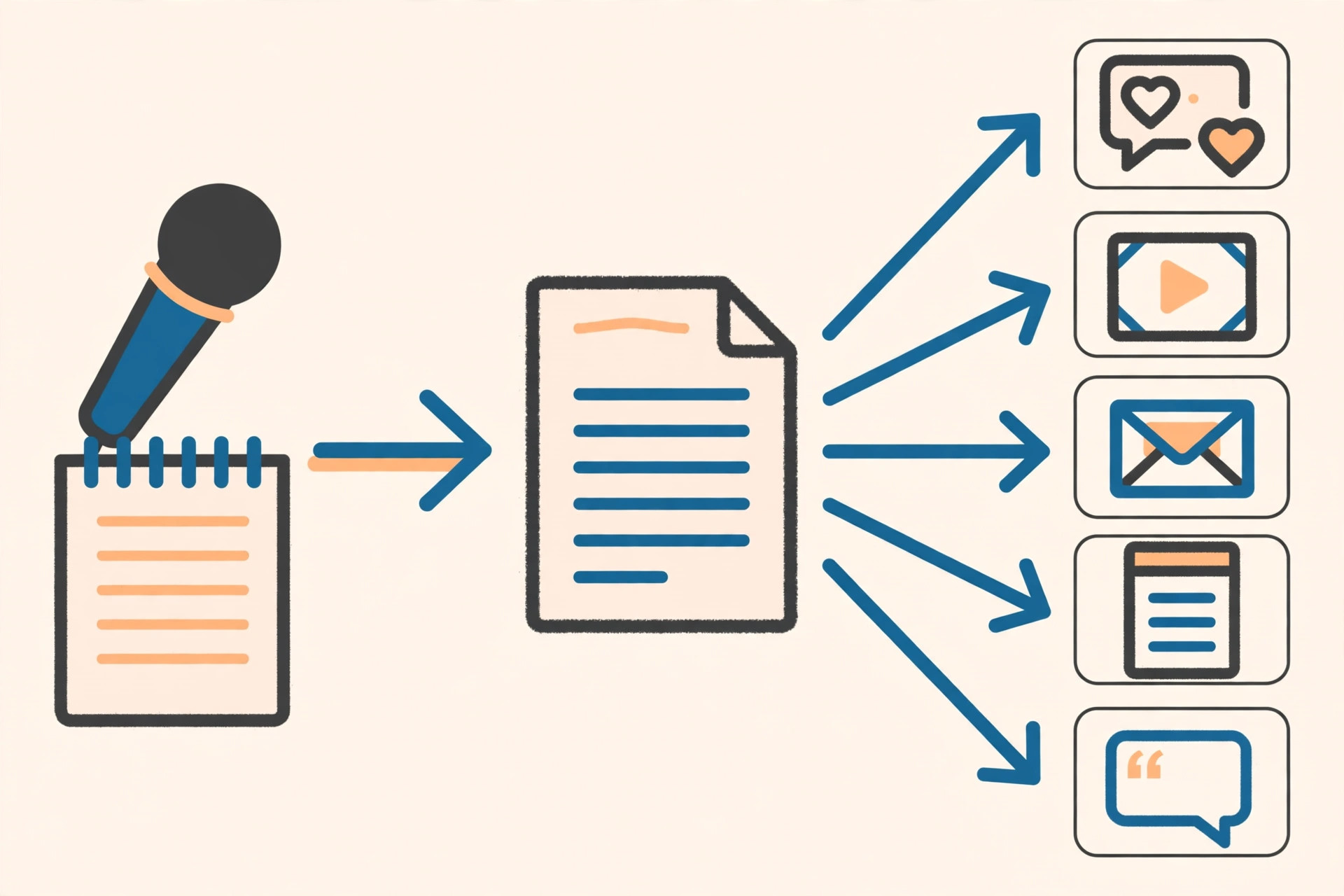
One good call usually yields five usable pieces, one per format. You do not need all five every week. Pick the two or three that fit the call, and let the rest go.
| Format | Made from | Why it works |
|---|---|---|
| Short post | One quotable sentence from the call | Real language beats polished copy, because it sounds like a person said it |
| Question post | A question the client asked | If one client asked it, others are wondering it, and the answer is your expertise |
| Behind the scenes post | A decision made on the call, with the reasoning | Shows how you think, which is what clients actually buy |
| Short video or Reel | One moment, retold to camera in 30 seconds | The call gives you the script, so recording takes minutes, not an afternoon |
| Email or newsletter item | The week's best moment, with one lesson attached | Turns a private conversation into a useful note for your whole list |
The key is that each piece starts from one moment, not from the whole transcript. A transcript is a mine. You do not carry the whole mine home. You take the one good stone and cut it.
The Workflow, Step by Step
Budget about 45 minutes per call, as a planning figure, not a measured average, once the template is set: about 5 minutes to set up the recording, about 20 minutes to extract and sort, and about 20 minutes to draft and approve the pieces you keep.
- Step 1: Ask before you record, every time. Tell the client at the start of the call that you record for notes, and that anything sensitive stays private. This is not just polite. It changes the call, because people speak more freely when they know the ground rules.
- Step 2: Mark the moments live. During the call, jot down the time or a keyword whenever something quotable is said. A transcript is long. A transcript with three bookmarks in it is a source you will actually use.
- Step 3: Extract with a fixed prompt, not a free-form ask. The prompt is simple: list the five most quotable sentences, the three best questions the client asked, and the two decisions made, with the exact wording and the time each appeared. If the model cannot find a quote in the transcript, it must say so, not invent one.
- Step 4: Sort before you draft. Put each extracted moment into one of the five formats, or discard it. A moment that fits no format is not a bad moment. It is a moment for next week's report, not this week's content.
- Step 5: Draft one piece at a time, from the moment only. Give the model the single quote or question and ask for a draft in your voice, under 150 words, with no new claims. A draft that invents context around a real quote is worse than no draft, because it puts words in a client's mouth.
- Step 6: Read the draft against the transcript. Check three things: is the quote accurate, is the context fair, and would the client be comfortable seeing this in public? If any answer is no, rewrite or kill the piece. A killed piece costs nothing. A published misquote costs trust.
- Step 7: Schedule the keepers across the week. Spread the pieces over the week instead of posting them all on the day of the call. One call, five pieces, five days of posting, and the call is still doing work on Friday.
What Breaks, and the Guardrail for Each
| Failure | Warning sign | Guardrail |
|---|---|---|
| A private moment goes public | A client messages you about a post, confused or unhappy | Ask before you publish anything from a call, and keep a do-not-share list per client |
| AI invents a quote | A sentence sounds too polished to be real, and the transcript does not contain it | Extract exact wording with timestamps, and check every quote against the transcript |
| Every post sounds the same | Your feed reads like summaries, not like you | Draft from one moment at a time, and rewrite the hook in your own words before posting |
| You record everything and use nothing | Transcripts pile up, no posts come out | Mark moments live, and sort within 24 hours, while the call is still fresh |
| Content eats the call | You steer the client toward quotable lines instead of listening | The call serves the client first. Content is a byproduct, never the agenda |
| The client feels mined | They go quiet on calls, or ask to stop recording | Pause the workflow, ask what changed, and rebuild around their comfort, not your calendar |
Rule: the call serves the client first, and content is a byproduct. If a piece would not survive the client reading it, do not publish it, no matter how good the hook is.
Lessons at the End
- One call, five pieces, five days. A single conversation, captured properly, is a week of content. The constraint is capture, not ideas.
- Mark the moments live. A transcript with three bookmarks beats a perfect transcript nobody opens.
- Extract exact words, never paraphrases. A real sentence from a real person is the whole advantage. An invented quote destroys it.
- Sort before you draft. A moment that fits no format belongs in the client report, not on your feed.
- The client reads it first, in your head. If you would hesitate to show them the post, do not publish it. Ask them instead.
- Spread the keepers across the week. One call should still be working for you on Friday, not burned out in a single afternoon of posting.
If you build only one thing from this post, build the live bookmark habit and the fixed extraction prompt: mark three moments during the call, then pull the exact quotes, the best questions, and the decisions made, with timestamps. That pair, run the same way after every call, is what turns conversations you already have into content you no longer have to invent.