
Disclosure: This article may contain affiliate links. We earn a commission at no extra cost to you if you purchase through our links. We only recommend tools we genuinely believe in.
The prospect wanted a full Meta ads rebuild, a new landing page, and a weekly reporting call, all starting Monday, for a budget that covered about a third of the work. I said yes anyway. I told myself the relationship would grow, the budget would grow with it, and the rush was a one-time thing. Three weeks later I was working nights on a scope I had never agreed to, for a client who measured success by a metric I had never promised, and I was the one who had set the whole thing up by saying yes to a deal I knew did not fit.
That is the gap this post closes. Saying yes to the wrong client costs more than saying no to the right one ever will. A bad fit eats your calendar, your energy, and your reputation, and it does it quietly, one small compromise at a time. The fix is a fit check that runs before the sales call ends, and a no that is fast, kind, and final, with AI doing the drafting so you never stall on the wording.
This post follows How I Onboard a New Client With AI (Without Dropping the Ball in Week One), because a clean no at the start is what keeps your onboarding clean later, and it pairs with How I Handle Scope Creep Without Losing the Client, because most scope creep starts as a bad fit you accepted and then tried to manage.
This is a playbook, not a results report. The scorecard below is a starting template to tune after your first few fit checks, not measured outcomes. Your clients and your rates will differ, so treat the numbers as a draft you calibrate, not a promise.
The Problem: A Bad Fit Rarely Looks Bad on the First Call
Bad fits do not arrive wearing a warning label. They arrive sounding excited, which is exactly why they get through. Three signs show up early if you know where to look.
- The scope is a moving target. The prospect describes the job three different ways in one call, and each version is bigger than the last. If you cannot write the scope in one sentence after the call, you do not have a scope, you have a wish list.
- The budget and the ask do not meet. The work they describe costs roughly twice what they have budgeted, and they expect the gap to close itself. Hope is not a pricing strategy, and a discount you give on day one becomes the rate they expect forever.
- The timeline is already on fire. Everything is urgent, everything starts Monday, and the urgency existed before they met you. Urgency that predates you is not your emergency, and a client who starts the relationship in a rush will run the whole relationship in a rush.
Any one of these is workable on its own. All three together is a no, and the sooner you say it, the cheaper it is for both sides.
The Fit Scorecard
Before the call, I score every prospect on five checks. Two reds means I pass, and I decide that before the call, not during it, because deciding live is how you talk yourself into a yes.
| Check | Green | Amber | Red |
|---|---|---|---|
| Scope | One clear deliverable, one sentence | Two or three related asks | A wish list that grows during the call |
| Budget | Matches the rate card | Close, with room to shape the scope down | Less than half of what the work costs |
| Timeline | A start date with breathing room | Tight but possible | Everything is due Monday, starting now |
| Decision maker | The person on the call can say yes | One more approval step | A committee, or no one who can decide |
| Working style | Async, one check-in a week | A mix of calls and messages | Daily calls and instant replies expected |
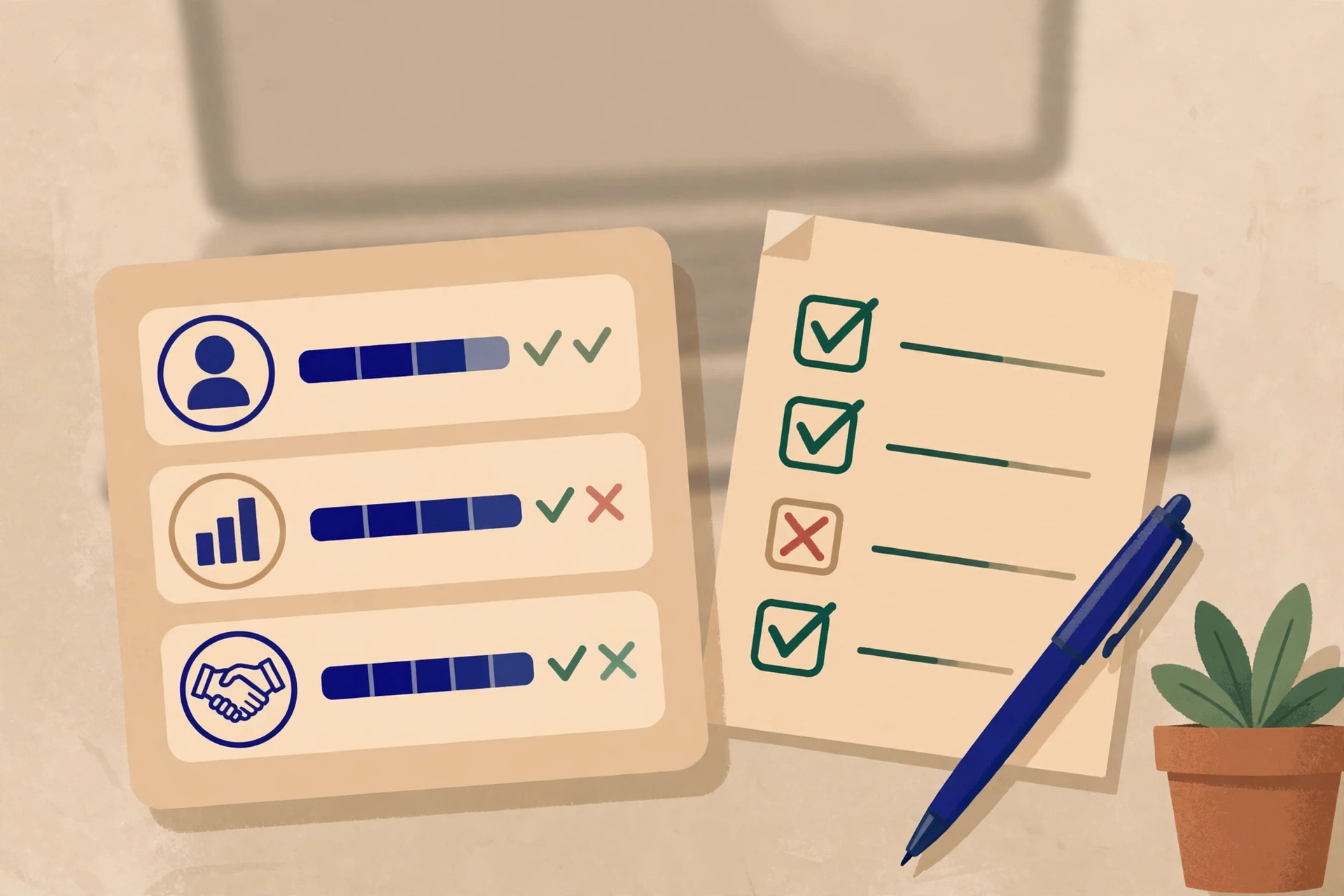
The scorecard is not a judgment on the prospect. A red is not a bad person, it is a bad match for how I work, and the kindest thing I can do is say so quickly and point them somewhere better.
The Stack
Nothing exotic. The point is that every piece has one job, and nothing lives in two places.
| Job | Tool I use | Why it fits |
|---|---|---|
| Intake and first screen | A short form (Typeform or Google Forms) | The answers arrive before the call, so the call is a check, not a discovery session |
| Fit scoring | Claude or ChatGPT, with the intake answers attached | Scores the five checks and flags the reds, so I walk in with a view already formed |
| The no, drafted | Claude or ChatGPT, from the scorecard | Three versions, one for each kind of no, so I never stall on wording |
| Referral handoff | A short list of people I trust | The no lands softer when it comes with a next step |
| Record | The client file | Every pass, and the reason, logged next to the prospect name |
Step 1: Score the Fit Before the Call
The intake form asks five questions, one per check: what is the one deliverable, what is the budget range, when does it need to start, who decides, and how do you like to work together. Short answers, no essays. I feed the answers to Claude and ask for a score on each check, with one line of reasoning per check, and a straight recommendation: take the call, shape the scope, or pass.
This step takes ten minutes and it does the most important job in the whole workflow: it moves the decision from the middle of a live conversation, where excitement and politeness push you toward yes, to a quiet moment beforehand, where you can think clearly. If the scorecard says pass, I do not take the call to double-check. The call is where good intentions go to die.
Step 2: The 15 Minute Fit Call
When the scorecard is green or amber, I take a short call with a fixed shape: five minutes on the goal, five minutes on the scope and the budget, five minutes on how we would work together. I do not pitch on this call. The call is a check, not a sale, and I say that at the start so the prospect relaxes.
Two rules keep it honest. First, I name the price range on the call, not after it. A prospect who cannot meet the range deserves to know in minute eight, not in an email three days later. Second, if a red shows up live, I say so on the call. Waiting to deliver a no by email after a warm call is slower for them and harder for me, and it is how a pass turns into a maybe, and a maybe turns into a yes you regret.
Step 3: The No, Written With AI, Sent by You
Most people do not struggle to decide. They struggle to write the message. So I keep three versions ready, drafted with AI from the scorecard, and I rewrite the first line by hand so it sounds like me.
- Wrong service. "This is not my lane, and you deserve someone who does it every day. Here is who I would call." Short, specific, and it names the better fit.
- Wrong budget. "The work you described needs a bigger budget than you have set aside, and I would rather tell you that now than deliver a cut-down version that disappoints you. If the budget moves, I would be glad to talk again."
- Wrong timing. "I cannot start this properly before your deadline, and a rushed start would hurt the work. Here is what a realistic timeline looks like, and I am happy to pick it up if the date can move."
Every version follows the same shape: one line of thanks, one line of honest reason, one line that helps them forward. No apology paragraph, no long explanation, no maybe. A clear no is a gift. A soft maybe is a slow no that wastes their week.
Step 4: The Referral Redirect
A no with a referral is a completely different message from a no on its own. I keep a short list of people I trust, sorted by what they do best, and I point the prospect to the right name. It costs me nothing, it helps the prospect, and it keeps the relationship warm in a way a flat rejection never does.
Two rules here. First, only refer people you would hire yourself, because your name is on the introduction. Second, tell the person you referred them before they get the call, so they are not surprised and they know what to expect. A sloppy referral is worse than no referral at all.
The Kill Rules
- Never let AI send the no. Every draft gets read by you first. A wrong name, a wrong reason, or a tone that does not sound like you turns a kind no into an insult.
- Never negotiate against your own scorecard. If the fit is red, a bigger budget does not fix a scope that changes weekly, and a later deadline does not fix a working style that needs daily calls. One check changing does not change the verdict.
- Never say yes to fill a gap in the calendar. An empty week is cheaper than a bad-fit month. The calendar fills again. A bad client stays until you end it, and ending it costs far more than the empty week ever did.
- Never ghost a prospect. A two-line no sent today beats silence every time. Silence is the one version of no that burns the bridge, because it tells the person they were not worth a reply.
What I Would Do Differently
The first time I ran a fit check, I scored a prospect amber on budget and green everywhere else, and I took the job with a smaller scope to fit the money. The scope crept back to full size within two weeks, the budget did not move, and I spent a month doing full-size work at a cut-down rate. The lesson was simple: a smaller scope only works if the scope actually stays smaller, and that is a promise the client has to keep, not a hope I carry alone.
The second mistake was waiting a week to send a no I had already decided on day one. I told myself I was being thoughtful. What I was actually doing was letting the prospect plan around a yes that was never coming. A no decided on Monday and sent on Friday is not kindness, it is a week of wasted planning.
Lessons
Saying no is not a sales skill, it is a capacity skill. Every yes to a bad fit is a no to a good client you have not met yet, and to the work you actually want to do. Run the fit check before the call, score it honestly, and send the no the same day you decide it, with a referral attached. The clients you turn away well are the ones who come back when the fit is right, and the ones who send their friends your way in the meantime. That is the whole return on a two-line email.