
Disclosure: This article may contain affiliate links. We earn a commission at no extra cost to you if you purchase through our links. We only recommend tools we genuinely believe in.
Every demo request used to land in my inbox as a small crisis. I had no sales team, no SDR, and no hours to spare for back-and-forth scheduling. So I either replied late, or I booked calls with people who were never going to buy, and both problems fed each other. Late replies made good prospects drift away. Bad calls ate the hours I needed for the good ones.
This post is the system that replaced that mess. It is a playbook, not a victory lap. It builds on the March demo qualification series, especially the AI Demo Request Qualification Playbook for B2B Teams, and it plugs directly into the scoring setup in How I Set Up AI Lead Scoring in 2026. If you run a small team, or no sales team at all, this is the version designed for you.
The Problem With Manual Demo Qualification
Manual qualification fails in a predictable way. It is not that founders are bad at judging fit. It is that judging fit takes a full context switch, and demo requests do not arrive one at a time on a tidy schedule. They arrive while you are building, while you are on another call, or at 11 p.m. on a Sunday.
So three things happen:
- Good requests wait. The reply comes hours later, after the prospect has already booked with someone else.
- Bad requests get calls anyway. Without a filter, politeness wins and the calendar fills with curiosity calls.
- Follow-up depends on memory. If you forget to reply, nobody else remembers either, because there is no system.
Automation does not fix this by being clever. It fixes it by being consistent. Every request gets the same check, the same next step, and the same paper trail, whether you are awake or not.
The System in One Pass
The stack is deliberately boring. No exotic tools, nothing that needs a dedicated owner.
| Stage | Tool | What happens |
|---|---|---|
| Capture | HubSpot form | One form, one set of questions, every request in the same place |
| Enrich | Clearbit or HubSpot enrichment | Company size, industry, and domain fill in automatically where available |
| Score | OpenAI or Claude plus your scoring rules | A short fit summary and a score band, not a black box verdict |
| Route | n8n | The score band decides the lane, no human triage in between |
| Book | Calendly or Cal.com | Book lane gets a booking link immediately, no email ping pong |
| Notify | Slack or email | Review lane lands in one queue, once a day, not as a stream of pings |
That is the whole pipeline. If a stage cannot explain itself in one sentence, it is too complicated for a team of one.
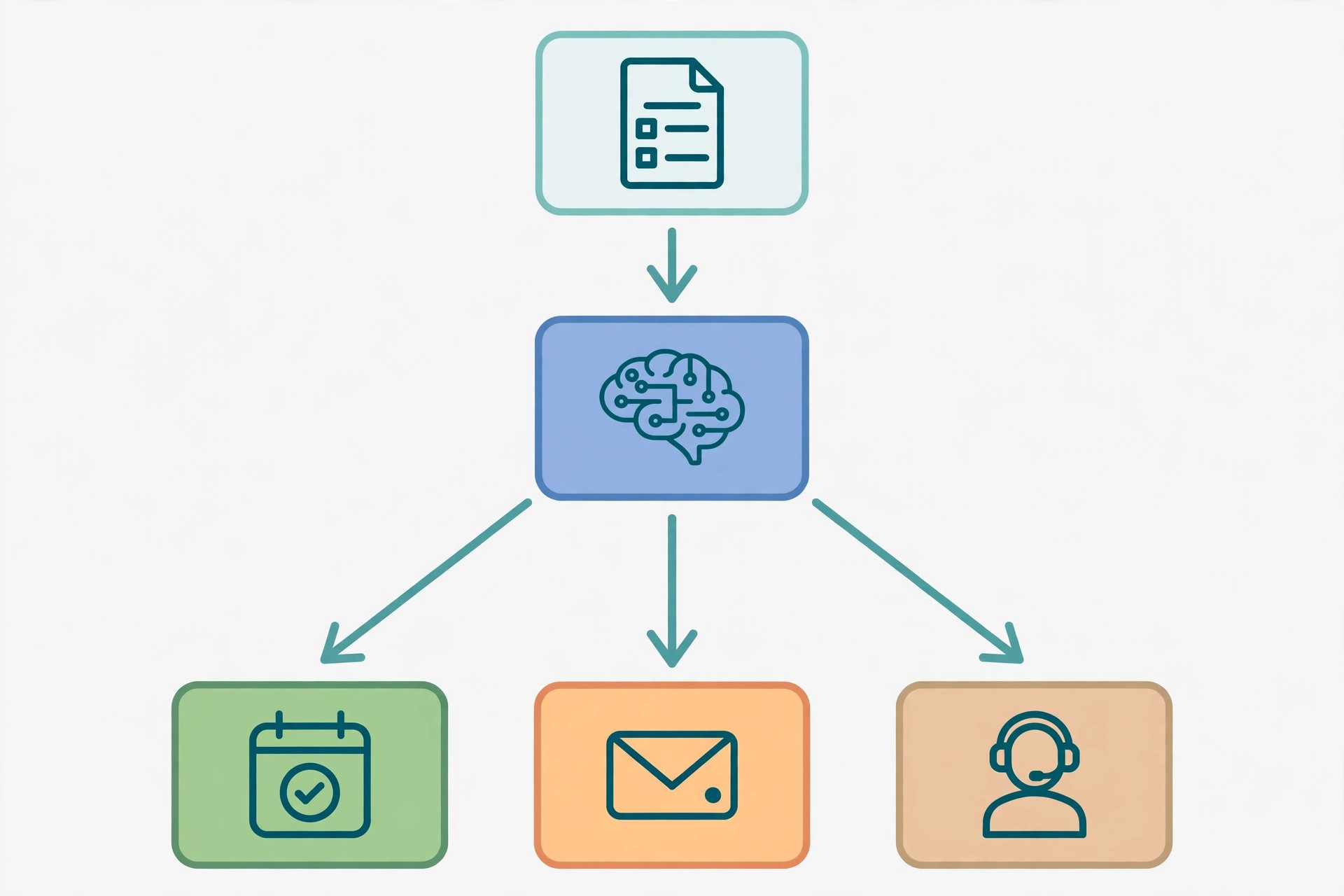
The Three Lanes: Book, Nurture, Review
Every request ends up in exactly one lane. The lanes are the system. Everything else is plumbing.
| Lane | Who goes there | Next step | Timing |
|---|---|---|---|
| Book | Clear fit, right role, real problem, realistic timing | Instant booking link plus a short prep email | Immediately |
| Nurture | Possible fit, wrong timing, or missing information | Useful resource plus a check-in sequence, no calendar link yet | Within an hour |
| Review | Unclear, unusual, or high value but odd looking | One human review queue, one reply from you | Within one business day |
Book is the only lane that gets the calendar. That is the whole discipline. If everyone gets the calendar, you do not have a qualification system. You have a form that books meetings.
Nurture is not rejection. It is a holding pattern with value in it: one guide, one teardown, one comparison that answers the question they actually asked. If they engage with it, they can move to Book later. If they do not, you spent no meeting time finding out.
Review is the safety valve. Anything the automation is unsure about goes there, and you check that queue once a day. Review exists so the system never has to guess on a request that matters.
The Qualification Questions That Actually Decide
Five questions do most of the work. More questions do not mean better qualification. They mean a longer form and fewer completions.
- What is your role? A buyer, a user, and a student ask for demos for completely different reasons.
- How big is the company? A size band, not an exact headcount. Bands are easier to answer honestly.
- What tool do you use today? The current tool tells you what they are replacing, and how painful that switch is.
- What problem are you trying to solve this quarter? A problem with a deadline is different from a problem with curiosity behind it.
- When do you want to start? Timing separates "someday" from "this month" better than any other single question.
The AI summary then answers three questions of its own: does this look like our customer, is the timing real, and is there anything odd here that needs a human eye. If any answer is "I do not know", the request goes to Review. Uncertainty is a lane, not an error.
The Prompt and the Starting Score Bands
Here is the shape of the prompt, not a magic incantation. It works because the criteria are written down before the first request arrives.
- Score fit from the form answers and enrichment data only. Do not invent company details that are not in the input.
- Return a one-paragraph summary, a fit band, and one reason for that band.
- Flag anything that looks like a competitor, a student project, a personal email with no company context, or a duplicate of an existing request.
- If information is missing, say so, and recommend Review instead of guessing.
The score bands below are starting thresholds to tune after your first month of use. They are planning defaults, not results, and your numbers will differ because your customer profile differs.
| Band | Meaning | Lane |
|---|---|---|
| 70 and up | Strong fit on role, size, problem, and timing | Book |
| 40 to 69 | Possible fit, or timing and information gaps | Nurture |
| Under 40 | Weak fit on the basics | Nurture with a light touch, or Review if the company is notable |
| Flagged | Competitor, duplicate, spam pattern, or missing core data | Review |
Rule: never auto-reject a request in silence. A nurture email is the floor. A person who is wrong today can be right in six months, and a silent rejection burns that bridge for free.
What Breaks, and the Guardrails
Every automation like this breaks in the same five places. Build the guardrail before you need it.
- Duplicates: match on email domain and company before creating a new deal, so one company does not get three parallel threads.
- Personal emails: do not auto-book a Gmail address with no company context. Send it to Review, where one look usually resolves it.
- Calendar abuse: cap bookings per day and per week. A full calendar is not a success metric if the calls are wrong.
- Broken links: test the booking link and the nurture emails once a week. Automation that silently fails is worse than no automation, because you stop checking.
- Stale questions: review the form questions every quarter. If a question never changes a lane decision, delete it.
The Weekly Upkeep: About 30 Minutes
This is a system, not a set-and-forget machine. Budget about 30 minutes a week, as a planning figure, not a measured average.
- Clear the Review queue, and note any request that should have gone to Book. That note is how the rules get better.
- Check one Book call and one Nurture thread. Did the prep email arrive? Did the resource make sense?
- Fix one thing: a question, a threshold, a broken link, a stale email. One fix a week compounds fast.
- Prune the nurture sequence if a link dies or a claim goes out of date. Old content in an automated email is still your content.
Lessons at the End
- Lanes beat scores. A score nobody acts on is trivia. A lane with a clear next step is a system.
- The calendar is the filter. Who gets the booking link is the real qualification decision. Everything else is commentary.
- Review is a feature, not a failure. A system with no human queue will eventually auto-book its way into a bad week.
- Start with five questions. You can always add a sixth later. You cannot recover the completions a twelve-question form cost you.
- Write the rules down. If the qualification logic lives only in your head, it dies the first week you are too busy to think about it.
If you have no sales team, you do not need a smaller version of an enterprise process. You need a tighter one: one form, three lanes, one review queue, and a booking link that only the right people ever see. Build that, run it for a month, and let the Review queue teach you what to change next.